
How Digital Tools Are Changing the Inner Life of Museums
Museums exist in a state of productive tension. They are custodians of the past, tasked with preserving objects and stories that define cultures, communities, and civilisations. Yet they are also institutions of the present, expected to remain relevant, accessible, and engaging in a world that moves faster with each passing year. This paradox sits at the heart of every museum, large or small, and it shapes everything from how exhibitions are designed to how audiences are welcomed through the door.
In recent years, digital transformation has begun to reshape this relationship between museums and the people who visit them. New tools, platforms, and technologies are offering institutions ways to connect with audiences that would have seemed unimaginable just a generation ago. Virtual reality experiences can transport visitors to ancient civilisations. Interactive touchscreens invite them to explore collections on their own terms. Social media allows museums to sustain relationships with visitors long after they leave the building. But what does the research actually tell us about how these tools are changing the visitor experience? And are they living up to the promise?
The key question is not simply whether digital tools are being adopted, but whether they are genuinely transforming how visitors engage with museum content. Are visitors becoming more active participants, or are they still largely passive observers who happen to encounter a screen along the way?
From Quiet Observation to Living Experience
George Hein's constructivist museum theory offers a useful starting point for understanding how museum experiences work.1 Hein argued that visitors do not simply absorb information from exhibitions in a straightforward, linear way. Instead, they actively construct meaning based on their own prior knowledge, interests, and experiences. A visitor who is a trained artist will see a painting exhibition differently from a visitor who is a primary school teacher. Both encounters are valid, but they produce quite different kinds of understanding.
This idea that interaction creates meaning has profound implications for how museums design their spaces and programmes. If the visitor is not a passive vessel to be filled with knowledge, but an active participant in creating their own experience, then the museum's role shifts. It becomes less about delivering information and more about creating environments where meaningful encounters can happen.
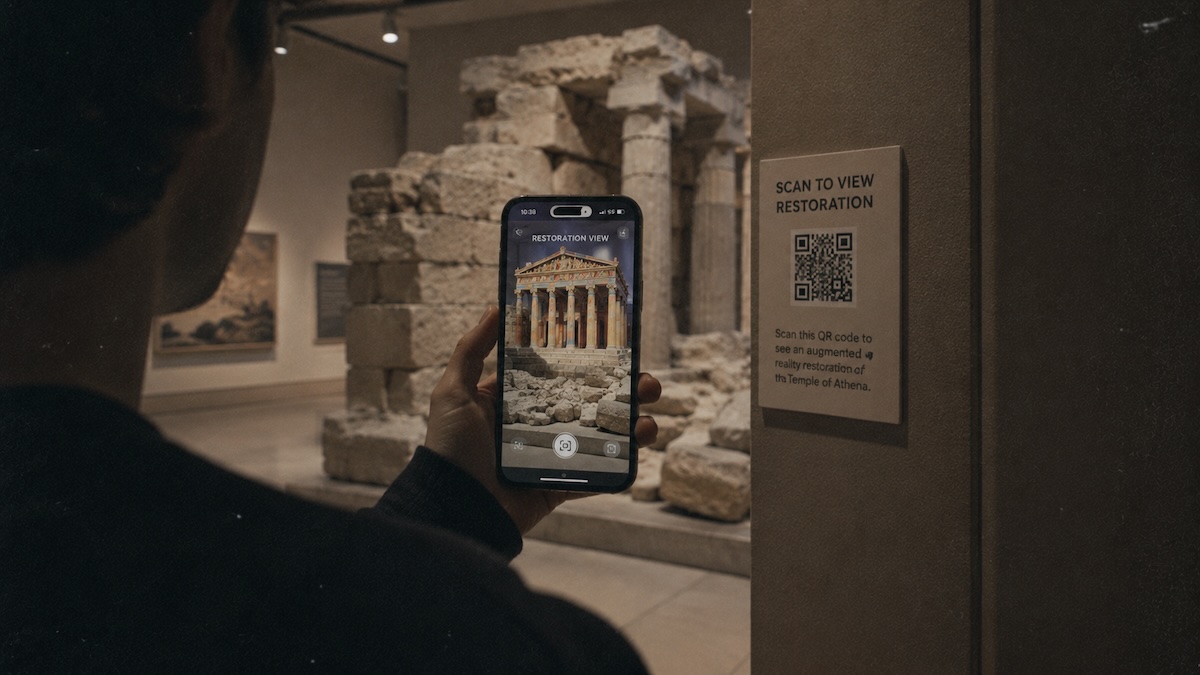
Digital technology is accelerating this transformation. Where once the visitor might read a label, look at an object, and move on, they can now scan a QR code for additional context, explore a 3D model of the object on a tablet, watch a short film about the artist's life, or even contribute their own response to a digital guestbook. Each of these touchpoints creates a new layer of engagement, and a new opportunity for the visitor to construct personal meaning from the experience.
Yet the challenge for museums is to balance guidance with participation. Too much direction and the experience feels prescriptive. Too little and visitors may feel lost, overwhelmed, or disengaged. Digital tools offer a way to thread this needle, providing structure and context while allowing visitors to choose their own path through the material.
Museums as Service Institutions
Alongside the constructivist view of learning, there is a parallel strand of thinking that positions museums as service providers. In this framework, drawn from service marketing theory, the visitor is understood as a consumer whose satisfaction depends on the gap between their expectations and their actual experience.2
Zeithaml, Parasuraman, and Berry's SERVQUAL model, originally developed for the commercial service sector, has been adapted by museum researchers to explore how visitors evaluate their experiences.3 The model identifies five dimensions of service quality: tangibles (the physical environment), reliability (consistent delivery), responsiveness (willingness to help), assurance (trust and confidence), and empathy (individualised attention). When museums fall short on any of these dimensions, visitor satisfaction drops, regardless of how impressive the collection might be.
Digital tools can strengthen several of these dimensions. A well-designed app can improve responsiveness by answering common visitor questions in real time. An interactive map can enhance tangibles by helping visitors navigate complex buildings. Personalised recommendations, powered by data about visitor behaviour, can offer the kind of individualised attention that the empathy dimension requires. In this sense, digital is not just about innovation for its own sake. It is about meeting the expectations of a public that increasingly takes seamless, personalised service for granted.
The Rise of the Experience Economy
Pine and Gilmore's concept of the experience economy provides another lens through which to view the museum's digital evolution.4 They argued that as economies mature, the focus of value creation shifts from commodities to goods, from goods to services, and from services to experiences. In the experience economy, what matters most is not the product or the service itself, but the memorable, personal encounter that surrounds it.
Museums are, in many ways, natural inhabitants of the experience economy. Their core offering has always been experiential: the chance to stand before an original work of art, to walk through a recreated historical scene, to hold a fossil in your hand. But Pine and Gilmore's framework suggests that experiences are not just about what is presented. They are about how the individual engages with what is presented. Two visitors can walk through the same exhibition and have entirely different experiences, depending on what they bring to the encounter and what the museum does to facilitate their engagement.
Digital tools amplify this personal dimension of the museum experience. They allow visitors to customise their journey, to access content that speaks to their specific interests, and to engage with material at a depth that suits them. A family with young children can follow one path through a digital guide, while a postgraduate researcher can follow another. The same collection serves both, but the experience is tailored and personal.
Digital Tools and the Reimagined Museum
The range of digital tools now available to museums is vast and growing. Social networks allow institutions to build communities of interest around their collections and programmes. Blogs and online articles offer a platform for deeper storytelling that goes beyond what a wall panel can convey. Virtual reality can recreate lost or inaccessible spaces, from ancient temples to bombed-out heritage sites. Augmented reality can overlay digital content onto the physical gallery, enriching the visitor's encounter with objects in real time.
But the impact of these tools is not limited to what the museum does for the visitor. Increasingly, visitors themselves are contributing to the digital life of the museum. They share photographs and reflections on social media, tag institutions in their posts, leave reviews, participate in online forums, and even contribute to crowdsourced cataloguing projects. The museum's audience is no longer a passive group of consumers. It is an active community of co-creators, and digital tools are what make this possible.
Visitors contribute through blogs, forums, and social tagging, adding their own interpretations and responses to the museum's collection. Some institutions have embraced this fully, inviting visitors to curate digital exhibitions or to annotate digitised objects with their own stories. Others are still finding their way, experimenting with how much control to share and how to maintain scholarly standards alongside public participation.
A Study of Visitors and Digital Engagement
A significant study by Coman, Grigore, and Ardelean examined how digital tools are shaping visitor engagement across four museums in Bucharest.5 The study surveyed 341 visitors across the National Museum of Art, the National Museum of Romanian History, the National Museum of the Romanian Peasant, and the Grigore Antipa National Museum of Natural History. The aim was to understand how visitors used digital tools before, during, and after their museum visits, and how this usage correlated with their overall experience.
The demographic breakdown of the survey revealed that the majority of respondents were female (63%), and most were aged between 18 and 35. A significant proportion held university degrees. The sample was heavily skewed towards younger, more educated visitors, which is worth bearing in mind when interpreting the findings. It tells us something about who is most likely to engage with digital tools in a museum setting, but it may not be representative of the broader visiting public.
The Museum Website as the Gateway
One of the study's most striking findings concerned the museum website. Of the 341 respondents, 36.6% reported using the museum's website before their visit. This is a substantial minority, and it suggests that the website functions as a crucial gateway to the physical museum experience. Visitors use it to check opening hours, plan their route, and get a sense of what exhibitions are on offer.
But the implications go further. The study found that visitors who engaged with the museum's website beforehand were more likely to describe themselves as active participants during their visit. This suggests that digital engagement before the visit primes visitors for a more involved, more invested experience once they arrive. A poorly designed or out-of-date website, by contrast, risks discouraging potential visitors before they even reach the door. The website is not just a practical tool. It is the first chapter of the visitor's story with the museum.
Digital Tools Before, During, and After the Visit
The study found that visitors used digital tools across the entire arc of their museum experience. Before the visit, they consulted websites, social media pages, and online reviews to plan and prepare. During the visit, they used smartphones to photograph objects, look up additional information, and share their experience in real time on social media. After the visit, they returned to digital platforms to leave reviews, share photographs, and recommend the museum to others.
This finding challenges the idea that the museum experience is bounded by the physical walls of the building. Digital tools extend it in both directions, creating a richer, more continuous relationship between the visitor and the institution. The visit itself becomes one episode in an ongoing conversation, rather than a standalone event.
What Visitors Actually Prefer
Perhaps the most revealing finding of the study was what visitors said they valued most. When asked about their preferred mode of engagement, direct interaction with exhibits emerged as the clear favourite, with 250 of 341 respondents selecting it. Visitors wanted to touch, see, and experience objects firsthand. Guided tours, workshops, and hands-on activities were also popular choices.
Digital tools, while appreciated, did not top the list. This is an important corrective to the assumption that technology is always the answer. Visitors value digital tools as an enhancement, not a replacement, for traditional forms of engagement. The screen is a supplement to the object, not a substitute for it. Museums that invest heavily in digital at the expense of the core physical experience may find that they are solving the wrong problem.
Why People Visit Museums
The study also explored visitors' motivations, and here the results confirmed what many museum professionals already suspect: education and entertainment coexist as primary drivers. Visitors come to learn, but they also come to enjoy themselves. They want to be informed, but they also want to be moved, surprised, and delighted.
This duality is important because it speaks to the kind of experiences museums need to create. A purely didactic approach, heavy on information and light on atmosphere, is unlikely to satisfy the modern visitor. Equally, an approach that prioritises spectacle over substance will leave visitors feeling entertained but not enriched. The best museum experiences manage to do both, and digital tools can help by offering layers of content that cater to different motivations.
Passive Spectators or Active Participants?
One of the study's most thought-provoking findings concerned the balance between passive and active engagement. When asked to describe their own behaviour, 47.1% of respondents identified as active participants, meaning they sought out information, asked questions, and engaged deeply with the material. However, 52.4% described themselves as passive spectators, content to observe and absorb without actively seeking to shape their experience.
Crucially, the study found a correlation between pre-visit website access and active behaviour. Visitors who had used the museum's website before their visit were significantly more likely to report active engagement during the visit itself. This suggests that digital tools can serve as a catalyst for deeper participation, not by replacing the physical experience but by preparing the visitor to get more out of it.
Satisfaction and the Desire to Return
Overall visitor satisfaction in the study was high, with an average score of 8.92 out of 10. The vast majority of respondents said they would recommend the museum to others, with 251 out of 341 saying they would do so. These are encouraging figures, but they also raise questions about what drives satisfaction and how digital tools contribute to it.
The study's findings suggest that satisfaction is driven by a combination of factors, including the quality of the collection, the design of the exhibition, the helpfulness of staff, and the availability of supporting resources, both physical and digital. Digital tools contribute to satisfaction not as a standalone feature but as part of a holistic experience. When they work well, they enhance the visit. When they are poorly implemented, they can actively detract from it.
The Museum of the Future
What this research tells us is that digital transformation in museums is not about replacing the traditional museum experience with a technological one. It is about enriching, extending, and personalising the relationship between the visitor and the institution. Digital tools work best when they serve the museum's core mission: to preserve, interpret, and share cultural heritage in ways that are meaningful, accessible, and inspiring.
The museum of the future will not be a virtual space that replaces the physical gallery. It will be a hybrid institution that uses digital tools to deepen the physical encounter, to reach new audiences, and to sustain relationships with visitors across time and distance. The challenge for museum professionals is to adopt these tools thoughtfully, guided by research and by a clear understanding of what their visitors actually need and value.
The evidence from Bucharest, and from the broader literature on museum studies and service marketing, suggests that visitors are ready for this future. They want to be active participants, not passive consumers. They want experiences that are personal, meaningful, and layered. And they want museums that meet them where they are, both physically and digitally. The institutions that get this right will not just survive the digital age. They will thrive in it.